Wood-based Panels
Wood-based panels combine wood in different forms (fibres, sawdust, chips, flakes and veneers) into sheets of differing thicknesses and constructions. Formed under heat and pressure typically with the addition of a synthetic adhesive (some fibreboard products utilise the natural binders found within wood), panels are engineered to provide a wide variety of strength and other physical attributes that enable them to satisfy a wide variety of end uses particularly in the building products and furniture industries.
The broad categories of wood-based panels manufactured by European Panel Federation members include:
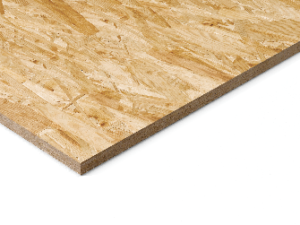
Particleboard
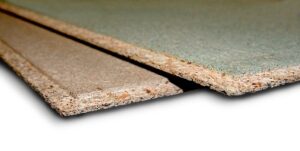
Particleboard is a wood-based panel manufactured under pressure and heat from particles of wood (flakes, chips, shavings, sawdust and similar) and/or other lignocellulosic material in particle form (flax shives, hemp shives, bagasse fragments and similar) with the addition of an adhesive.
How is it made?
Wood chips comprise the bulk of particleboard and are prepared in a mechanical chipper generally from coniferous softwoods, principally spruce, although pine and fir and hardwoods, such as birch, are sometimes used. Particleboards may also incorporate a large proportion from recycled sources. These chips are generally bound together with synthetic resin systems. The chips are formed into a mat and are then pressed between heated platens to compress and cure the panel. The finished panels are then sanded and cut to size.
What is it used for?
Large quantities of particleboard are used in the manufacture of kitchen units and worktops, as well as in dining-room and bedroom units; these generally have a veneered or laminated finish. In construction applications its good mechanical performance, which is the same along and across the panel, renders it appropriate for use as floor decking, and in doors. Packaging is another common application for particleboard, or chipboard as it is often known.
Properties
Moisture resistance, high mechanical performance, fire retardance and acoustic insulation are all properties which can be achieved by using specific types of particleboard.
MDF
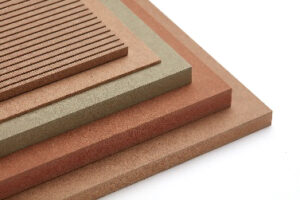
Dry process fibreboards are engineered wood-based panel materials made by bonding together wood fibres with a synthetic resin adhesive. Depending on the degree of pressing different types are formed. The most common is Medium Density Fibreboard, known as MDF.
How is it made?
MDF can be manufactured with either softwood or hardwood species. Most MDF is composed primarily of softwood, although some individual brands may contain a higher percentage of temperate hardwood. A typical process involves reducing wood down to small chips, which are then thermally softened and mechanically refined into fibres. These are then mixed with a synthetic resin binder. The resinated fibres are dried and then formed into a mat ready for pressing. The mat is pressed between heated polished press plates to the desired thickness.
What is it used for?
Standard MDF is used to manufacture tabletops, door panels and drawer fronts with moulded edges or profiled surfaces. The smooth and stable surfaces of MDF provide an excellent substrate for painting or applying decorative foils or wood veneers. MDF, or specifically its variation HDF, is the primary substrate for laminate flooring.
Properties
Moisture resistant boards are used for bathroom fitments, doors, window boards and other interior building applications where resistance to damp conditions are important requirements.
Flame retardant boards are increasingly used for fitted furniture, doors and panelling in public buildings and other areas which are required to conform to specific fire regulations.
OSB
OSB is an engineered wood-based panel material in which long strands of wood are bonded together with a synthetic resin adhesive. OSB is usually composed of three layers, with the strands of the outer two layers orientated in a particular direction, more often than not in the long direction of the panel.
How is it made?
The timbers used in OSB manufacture include both softwoods (spruce, pine) and hardwood (aspen). Wood strands are cut tangentially from debarked logs which are held longitudinally against rotating knives. After drying, these flakes are generally sprayed with a synthetic resin binder and wax and then bonded under heat and pressure between steel belts
What is it used for?
Because of its lay-up and composition, OSB is primarily a panel for construction and is widely used for flooring, flat roof decking and wall sheathing.
Properties
OSB’s strength mainly comes from its uninterrupted wood fibre, interweaving of long strands and the degree of strand orientation in the surface layers. Waterproof and boil proof resin binders are combined with the strands to improve internal strength, rigidity and moisture resistance.
HARDBOARD
Hardboards are formed with wood fibre and made by high pressure compression and temperature during a pressing process.
How is it made?
Wet process fibreboards are made by reducing steamed wood into fibres and by using the natural lignins as a binder during the pressing process. Depending on the degree of pressing involved, and hence the final density of the panel, the product is termed softboard or hardboard.
What is it used for?
Raw and lacquered hardboard panels are used in many applications including construction, packaging, furniture, upholstery, toys, and automobile and caravan interiours. Hardboard is often required for packaging of fruits, vegetables and mineral water bottles because it is a natural product.
Properties
The high-density boards satisfy the most demanding applications as a result of tempering or other treatments that achieve great physical and mechanical characteristics and excellent dimensional stability. Producers can offer customers additional special services including cut to size, and drilling and milling. More about Natural Fibre Board.
Softboard
Softboards are formed with wood fibre and made by pressure compression and temperature during a pressing process. They can be either rigid or flexible.
How is it made?
Wet process fibreboards are made by reducing steamed wood into fibres and by using the natural lignins as a binder during the pressing process. Depending on the degree of pressing involved, and hence the final density of the panel, the product is termed softboard or hardboard.
What is it used for?
Softboard panels are used mainly for insulation. Softboards insulate against the cold and also prevent overheating during summer months. In addition, they act as acoustic barriers against the transfer of noise.
Easy to install softboards are used in various building shell applications, roofs, walls and floors. End-users realize substantial savings on building costs and improved performance when compared with rendered masonry construction.
Properties
Softboards are non-toxic and non- irritating; they are easy to handle for installers and provides zero emissions once fitted.
PLYWOOD
Plywood consists of fine sheets of wood, or veneers bonded with glue. Plywood is a versatile product that can combine attractive surface appearance with superior performance under hazardous conditions while retaining comparatively high strength-to-weight ratios. It is available in a range of wood species, including hardwood and softwood species and combinations of the two, and a range of resin types for interior, high humidity and exterior conditions. Plywood was the first type of board developed to provide panels with dimensional stability and good strength both along and across the panel.
How is it made?
Plywood is generally made from veneers that are peeled from a log. These are bonded together with an adhesive that is appropriate to the end use, with the grain of adjacent veneers generally at right angles to each other, known as “cross grain”. The adhesive is cured by pressing the panel using heated platens. Plywood is processed on a worldwide basis using a wide range of timber species including softwoods and temperate or tropical hardwood.
What is it used for?
Plywood is commonly used in construction, for transportation, for packaging, for furniture and for decorative applications. Completely versatile, it is also suitable for the most extreme uses, amongst others for ship and boat building.
Properties
Light and easy to install, plywood offers excellent resistance to creep (the disforming of the wood due to weight bearing). Its cross-layer construction offers good stability and high resistance to impacts and weathering in all board directions. Depending on the type, it is suitable for both interior and exterior applications.
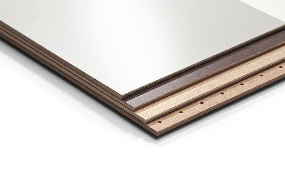
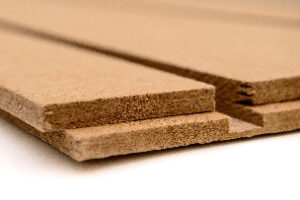
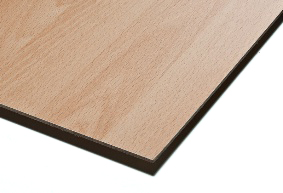
Within these broad categories, there are a multitude of value-added variants available with enhanced characteristics which is why today wood-based panels are used extensively in the home, in modern furniture and in construction. Although often hidden beneath coatings, veneers and other coverings, or embedded in the structural fabric of a building, wood-based panels are ubiquitous in our society.